Mastering Kubernetes Secrets: Why Vault Secrets Operator Is the Modern Standard
The Challenge of Secret Management at Scale
Platform teams managing Kubernetes often discover a critical security gap when scaling environments. Even with enterprise platforms like Red Hat OpenShift—which addresses many security concerns—the underlying Kubernetes core still presents similar challenges. Native Kubernetes Secrets are not designed to meet enterprise governance needs. As environments expand across clusters and clouds, the question evolves from “How do I get a secret into my pod?” to “How do I manage the entire lifecycle—generation, injection, rotation, and revocation—without slowing development?”
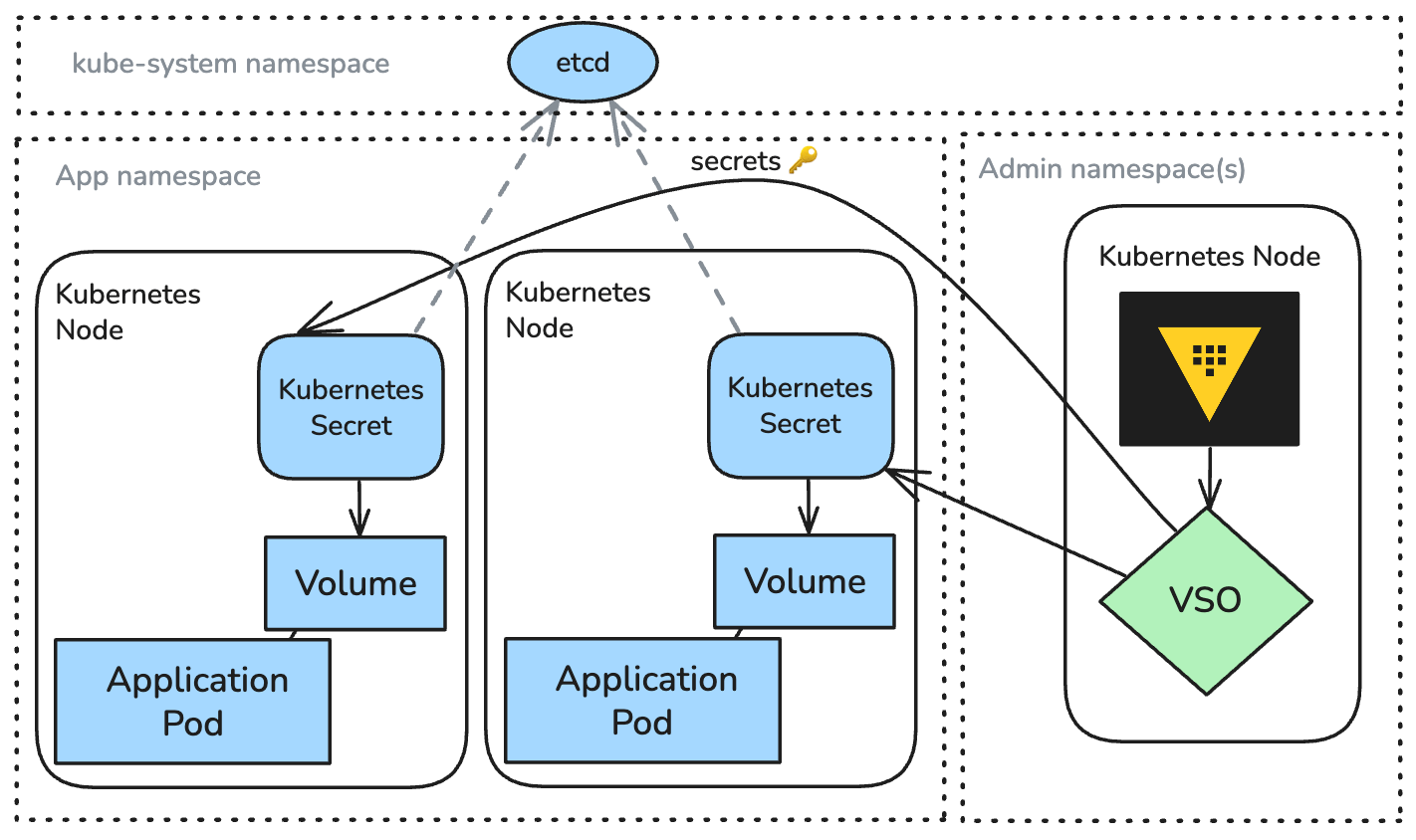
Managing sensitive data and identity-based access across hybrid clouds has become a top priority. Reliable, scalable, and secure secret delivery to production workloads is now table stakes. Organizations must go beyond or enhance native Kubernetes Secrets, especially since most secrets are used outside Kubernetes as well. A centralized, platform-agnostic secret management solution is clearly needed.
Vault has become the widely adopted enterprise standard for centralized secrets management, including for Kubernetes and OpenShift. However, teams need a pattern that standardizes delivery and lifecycle automation in these environments. Multiple Vault integration patterns exist, each with distinct operational and security tradeoffs. This article demystifies these methods, explains their tradeoffs, and shows why the Vault Secrets Operator (VSO) is now the recommended standard for modern delivery—without changing how you already interact with secrets in your pods.
Integration Methods Overview
We will cover the following Vault integration approaches:
- Vault Secrets Operator (VSO)
- VSO protected secrets (VSO with a built-in CSI companion driver)
- Secrets Store CSI driver (SSCSI)
- Vault sidecar agent injector
- Third-party secrets operators
Historically, many teams defaulted to the Vault agent sidecar injector, as it was the first robust solution. But as the partnership between HashiCorp and Red Hat deepened through IBM, a modern Kubernetes-native approach was introduced: the Vault Secrets Operator (VSO).
Vault Secrets Operator (VSO): The New Standard
VSO is a Kubernetes operator that synchronizes secrets from Vault into Kubernetes Secrets. It natively integrates with the Kubernetes API, allowing platform teams to define secret lifecycle policies declaratively. VSO handles authentication, secret rotation, and revocation automatically. It works seamlessly with existing workloads because pods still consume regular Kubernetes Secrets—no code changes or sidecar containers are required.
Key Benefits of VSO
- Kubernetes-native: Uses custom resource definitions (CRDs) familiar to operators.
- Lifecycle automation: Secrets are automatically rotated when they change in Vault.
- Security: No need to mount Vault tokens or expose Vault to every pod.
- Performance: Reduces overhead compared to sidecar injection.
VSO is production-ready and recommended by HashiCorp for new deployments.
VSO Protected Secrets: Enhanced Security with CSI Companion
For environments requiring even stricter security, VSO can be paired with a CSI (Container Storage Interface) companion driver. In this pattern, secrets are never written to etcd as Kubernetes Secrets. Instead, they are mounted directly as volumes into pods using the CSI driver. This approach, called “VSO protected secrets,” eliminates the risk of secrets persisting in Kubernetes storage. It is ideal for compliance-heavy industries such as finance or healthcare.
Secrets Store CSI Driver (SSCSI)
Another option is the Secrets Store CSI driver, which allows mounting secrets from external stores (like Vault, AWS Secrets Manager, Azure Key Vault) into pods as volumes. It provides a provider model; for Vault, a Vault provider must be installed. The CSI driver handles rotation by remounting the volume when secrets change. However, it requires running privileged containers and may have performance overhead due to per-node daemon sets. SSCSI is a viable option but adds complexity compared to VSO.
Vault Sidecar Agent Injector
The Vault sidecar agent injector was the first widely adopted pattern. It uses a mutating admission webhook to inject a Vault agent sidecar container into pods. The sidecar authenticates with Vault, retrieves secrets, and writes them to a shared emptyDir volume. While functional, this approach has several drawbacks: it increases pod startup time, consumes extra resources, and requires changes to pod specifications. It also exposes the Vault agent binary inside pods, which can be a security concern. For these reasons, HashiCorp now recommends VSO over the sidecar injector for most use cases.
Third-Party Secrets Operators
Several third-party operators also exist, such as External Secrets Operator (ESO) or Kubernetes External Secrets. These operators can fetch secrets from Vault and sync them to Kubernetes Secrets. They offer flexibility but may lack deep integration with Vault features like dynamic secrets, leasing, and rotation policies. Additionally, relying on non-standard tools can introduce maintenance overhead and compatibility risks. VSO, being developed by HashiCorp, ensures first-class Vault support and timely updates.
Choosing the Right Approach
When selecting a method, consider your organization’s security requirements, operational complexity, and existing infrastructure. VSO is the recommended standard for most teams because it balances simplicity, security, and automation. For the highest security, pair VSO with the CSI companion driver. The sidecar injector and SSCSI may still be used in specific scenarios, but they come with tradeoffs. Third-party operators should be evaluated carefully.
Conclusion
As Kubernetes environments grow, managing secrets efficiently and securely is paramount. Vault Secrets Operator offers a modern, Kubernetes-native way to automate secret lifecycle management without slowing development. By centralizing secret governance in Vault and leveraging VSO, platform teams can scale securely across clusters and clouds. Adopt VSO today to future-proof your secret management strategy.
Related Articles
- How to Stay Productive with Ubuntu During a Service Outage
- How to Effectively Respond to a Source Code Repository Breach: A Step-by-Step Guide Inspired by the Trellix Incident
- Cyber Crisis Unfolds: EU Commission Breach, Hasbro Attack, and AI Threats Dominate Week's Security Landscape
- New CLI Tool ThreatLens Revolutionizes Log Triage After Event Viewer Failure
- Iranian Hackers Breach FBI Director’s Gmail, Leak Personal Data in Retaliation for Domain Seizures
- Critical Linux Flaw 'CopyFail' Poses Widespread Risk to Servers and Devices
- The Snow Flurries Campaign: How UNC6692 Used Helpdesk Impersonation and Custom Malware to Breach Networks
- Perimeter Breakdown: Why Edge Devices Are Now Attackers’ Favorite Entry Point