How to Transport and Assemble NASA's SLS Core Stage for Artemis III
How to Transport and Assemble NASA's SLS Core Stage for Artemis III
Moving a giant rocket stage is no small feat. The core stage of NASA's Space Launch System (SLS) for the Artemis III mission recently made a 900-mile journey from New Orleans to Florida, culminating in its arrival at the Vehicle Assembly Building (VAB) at Kennedy Space Center. This guide breaks down the process behind that epic move—from manufacturing to final assembly—so you can understand exactly what it takes to get a Moon rocket ready for launch.
What You Need
- SLS Core Stage — The largest section of the rocket, manufactured at NASA's Michoud Assembly Facility in New Orleans.
- Pegasus Barge — A specialized transport vessel designed for moving massive rocket components.
- Vehicle Assembly Building (VAB) — The towering facility at Kennedy Space Center where the rocket is stacked.
- Orion Spacecraft — The crew module that will ride atop the SLS rocket.
- Commercial Lunar Lander — The spacecraft that will dock with Orion to take astronauts to the Moon's surface.
- Team of Engineers and Technicians — Skilled personnel to oversee every step of the move and assembly.
Step 1: Manufacture the Core Stage at Michoud Assembly Facility
Before any transport can happen, the core stage must be built from the ground up. At NASA's Michoud Assembly Facility in New Orleans, teams weld together large aluminum alloy barrels, attach the four RS-25 engines, and integrate the avionics and fuel systems. This process takes months of precision work. Once complete, the core stage is the backbone of the SLS rocket, standing 212 feet tall and measuring 27.6 feet in diameter.
Step 2: Load the Core Stage onto the Pegasus Barge
With the core stage finished, the next challenge is moving it from the factory to the water. A heavy-lift transporter carefully positions the stage onto a specialized cradle. Then, a crane lifts the entire assembly onto the Pegasus barge, a vessel that was custom-built to carry SLS components. The barge has climate-controlled bays to protect sensitive hardware during the journey. Teams secure the stage with heavy-duty straps and shock absorbers to ensure it stays safe through waves and weather.
Step 3: Transport the Core Stage 900 Miles by Barge
Once loaded, Pegasus begins its 900-mile journey from New Orleans down the Mississippi River, across the Gulf of Mexico, and up the Atlantic coast to Port Canaveral, Florida. The voyage typically takes about five days, depending on weather and river traffic. Tugboats guide the barge at a steady pace—slow enough to prevent jarring but fast enough to meet tight launch schedules. During the trip, monitoring systems track temperature, humidity, and vibration. If any readings go outside safe limits, the crew can adjust conditions immediately.
Step 4: Offload and Move into the Vehicle Assembly Building
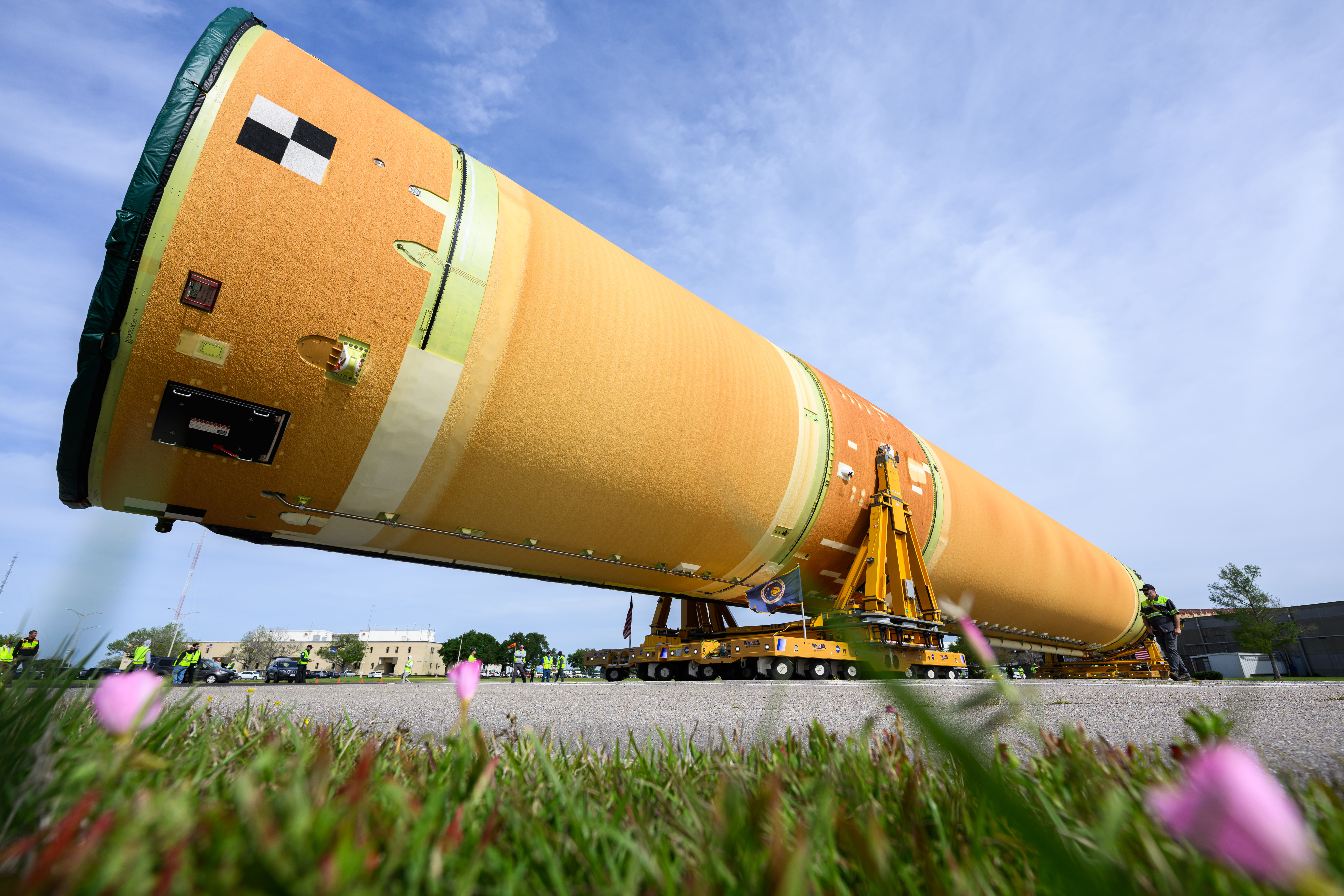
After Pegasus docks at Kennedy Space Center's turn basin, the core stage is lifted off using a massive crane and placed onto a specialized transporter. Teams then drive the stage—still in its protective cradle—through the center's roads, past the iconic countdown clock, and directly into the Vehicle Assembly Building (VAB). On April 27, 2026, this exact step was photographed as the stage crept into the VAB's high bay. Getting the stage inside requires precise coordination: the transporter must line up perfectly with the building's 456-foot-tall doors.

Step 5: Assemble the SLS Rocket by Stacking the Core Stage
Inside the VAB, technicians lift the core stage vertically and lower it onto a mobile launcher platform. Then they attach the two solid rocket boosters (already assembled on the sides) and later the upper stage and Orion spacecraft. This stacking process is done step by step, with each connection tested for leaks and structural integrity. The fully assembled SLS rocket will stand about 322 feet tall once complete.
Step 6: Launch Crew Aboard Orion to Test Docking Capabilities
With the rocket assembled, the Artemis III mission is set. The crew will board the Orion spacecraft, which sits on top of the SLS. After liftoff, Orion will travel to lunar orbit, where it will test rendezvous and docking with a commercial lander. This is a critical step before astronauts can actually descend to the Moon's surface. The core stage's journey—from Michoud to the VAB—makes this entire mission possible.
Tips for a Successful Move
- Plan for the weather: Barge travel can be delayed by storms; always have alternative docking schedules ready.
- Double-check seal integrity: The core stage must remain at constant humidity to prevent corrosion; monitor seals on the barge's cargo hold.
- Practice the VAB entry: The high bay door opening is tight; run simulations with a mock stage to avoid scrapes or misalignment.
- Coordinate with maritime traffic: Notify local ports and the Coast Guard in advance to clear the route.
- Keep a backup transporter: If the main transport vehicle breaks down, have a secondary system ready to avoid leaving the stage stranded.
Related Articles
- Zero-Day 'PhantomRPC' Flaw Lets Attackers Seize Full Control of Any Windows System
- The Sudden Spike: Why Illinois Gas Prices Now Lead the Nation Outside the West Coast
- Samsung Galaxy Book6 Ultra: A MacBook Pro Copy That Falls Short
- IEEE Honors Ana Inês Inácio with Prestigious Young Professional Award for RF Sensor Innovation
- How to Decode a Hubble Space Telescope Image: A Guided Tour of Spiral Galaxy NGC 3137
- 10 Key Breakthroughs of RecursiveMAS for Multi-Agent Systems
- 7 Surprising Facts About Your Brain's Built-In 'Stop Scratching' Mechanism
- Elon Musk's SEC Settlement: A Costly Lesson or a Bargain?