V8's Faster JSON.stringify: A Technical Deep Dive
JSON.stringify is a critical JavaScript function for converting objects into JSON strings. Its speed directly influences web performance—from saving data in localStorage to sending payloads over the network. Recently, the V8 team achieved a more than twofold speedup in JSON.stringify through a combination of architectural and low-level optimizations. This Q&A breaks down the key changes, including the new side-effect-free fast path, the shift to an iterative algorithm, and specialized handling of string representations. We'll also explore the practical impact and limitations of these improvements.
What made JSON.stringify more than twice as fast in V8?
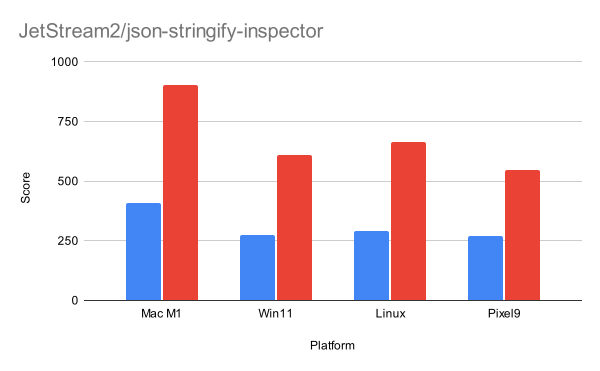
The performance leap came from two major optimizations. First, V8 introduced a dedicated fast path for serializing objects that are guaranteed to be free from side effects—any operation that could alter program state or trigger garbage collection during serialization. This fast path dramatically reduces the overhead of type checks and defensive safeguards used in the general-purpose serializer. Second, the underlying algorithm was redesigned from a recursive model to an iterative one. This change eliminates stack overflow checks and allows the engine to resume quickly after encoding adjustments. Together, these enhancements cut serialization time by over 50% for the most common JavaScript objects, such as plain data structures.
How does the side-effect-free fast path work?
The key insight is that many objects serialized via JSON.stringify are simple data containers—no getters, no proxies, no custom toJSON methods, and no prototype chain hooks. When V8 can statically prove that no user-defined code will run and that the serialization won't trigger a garbage collection cycle, it switches to a highly optimized code path. This path avoids expensive runtime checks like verifying each property descriptor or handling edge cases like property deletions. Instead, it performs a streamlined, direct traversal of the object's own enumerable properties. The result is a significant speedup, especially for arrays and objects with many fields. However, as explained in Limitations, this fast path is only available when V8 can confidently assert no side effects exist.
Why is the iterative approach faster than recursive?
The original JSON.stringify used recursion to walk the object graph. Although straightforward, recursion has drawbacks: each recursive call consumes stack space, requiring bounds checks to avoid stack overflows. Moreover, depth limits restrict how deeply nested objects can be serialized. The new iterative implementation maintains its own explicit stack structure, which can be managed more efficiently. This change eliminates per-call stack overflow checks and allows the serializer to pause and resume cheaply when encoding formats change. As a result, the iterative version can handle much deeper nesting (beyond the typical 10,000-level recursion limit) and runs faster because it avoids function call overhead. For most real-world JSON payloads—which are often flat or moderately nested—this translates to a noticeable performance gain.
How does handling different string representations improve performance?
V8 internally stores strings in one of two forms: one-byte (Latin-1) for ASCII content, using 1 byte per character, or two-byte (UTF-16) for strings containing non-ASCII characters, using 2 bytes per character. Previously, the string serializer had to constantly branch on the character type, which added overhead. The updated implementation templatizes the stringification code on the character width. This means V8 now compiles two specialized versions of the serializer: one optimized entirely for one-byte strings and another for two-byte strings. While this increases binary size, it eliminates runtime type checks and branch mispredictions within the hot loop. Furthermore, the code efficiently handles mixed encodings by inspecting each string's instance type early; if a ConsString (which might trigger GC during flattening) is encountered, it falls back to the slow path. This specialization yields a substantial speed boost for typical APIs that mostly deal with ASCII JSON.
What are the limitations of these optimizations?
The fast path is only activated when V8 can guarantee that serialization causes no side effects. This guarantee breaks if the object has:
- Getter properties (which execute user code)
- Proxy objects (intercept property access)
- Custom
toJSONmethods - Properties with
valueOfortoStringthat aren't primitive-safe - Objects with
Symbol.toPrimitivehooks - Non-trivial prototypes that might intercept
enumerateorgetOwnPropertyDescriptor
Additionally, certain string types like ConsString require flattening, which can trigger garbage collection, forcing a fallback to the slower path. Similarly, serializing ArrayBuffer views or TypedArrays may involve side-effect-prone operations. For these cases, V8 still uses the robust but slower general-purpose serializer. Thus, while the optimization covers a large proportion of everyday JSON.stringify calls, developers working with exotic objects or extensive metaprogramming may not see the full benefit.
How does this speedup affect real-world applications?
In modern web development, JSON.stringify is used pervasively: sending data via fetch(), caching responses in service workers, storing complex state in localStorage, and communicating between frames or workers. A twofold speed improvement means that for a 100 KB JSON payload, serialization time drops from ~2 ms to ~1 ms. While that seems small, the cumulative effect on page loads, real-time updates, and large data processing can be significant. For example, React applications that serialize component state for server-side rendering or rehydration will see faster initial renders. Server-side Node.js deployments handling thousands of requests per second also benefit directly. Benchmarks from the V8 team show that typical e-commerce product listings and data-heavy dashboards can see up to a 2.3x reduction in serialize overhead. This optimization works transparently—no code changes are required—so every V8-based JavaScript runtime (Chrome, Node.js, Deno, etc.) immediately enjoys the improvements.
Are there more optimizations planned for JSON.stringify?
The V8 team continues to explore further improvements. Potential areas include optimizing the serialization of Map, Set, and other collection types (currently serialization of those is not natively supported by JSON.stringify). Another avenue is reducing memory allocation during string building by reusing buffers or using incremental output. There's also interest in applying similar side-effect-free fast paths to other JSON-related APIs like JSON.parse. However, any future work must balance performance gains against code complexity and binary size. For now, the current doubling of speed is a significant win for all JavaScript developers, and it's a great example of how low-level engine optimizations can improve user experience without developer effort.
Related Articles
- Unlocking the Web's Potential: The Block Protocol and the Future of Semantic Data
- 7 Key Optimizations That Made JSON.stringify Twice as Fast in V8
- How to Create 3D Rotations with CSS rotateY()
- GCC 16.1 Ships with C++20 Default, Experimental C++26 and Algol68 Support
- Accelerating Web App Startup: How Explicit Compile Hints Supercharge V8
- Building Apple’s Vision Pro Scrolly Animation with Pure CSS
- 10 Strategies for Optimizing Diff Line Performance in Pull Requests
- New Browser-Based Tool Enables Instant PDF Watermarking Without Uploading Files