V8 Engine Delivers 2.5x Performance Leap in Async File System Benchmark with Clever Heap Number Optimization
V8 Achieves Major Speed Boost in JetStream2 Benchmark
Google's V8 JavaScript engine now runs the async file system (async-fs) benchmark 2.5 times faster than before, thanks to a targeted optimization that eliminates wasteful memory allocations. The improvement, detailed by the V8 team, directly impacts the JetStream2 overall score and mirrors patterns found in production code.
“We identified a performance cliff where a frequently updated numeric variable forced repeated heap allocations,” said a V8 engineer. “By avoiding those allocations, we saw an immediate 2.5x gain in the async-fs test.”
The Bottleneck: Custom Math.random and HeapNumber Allocations
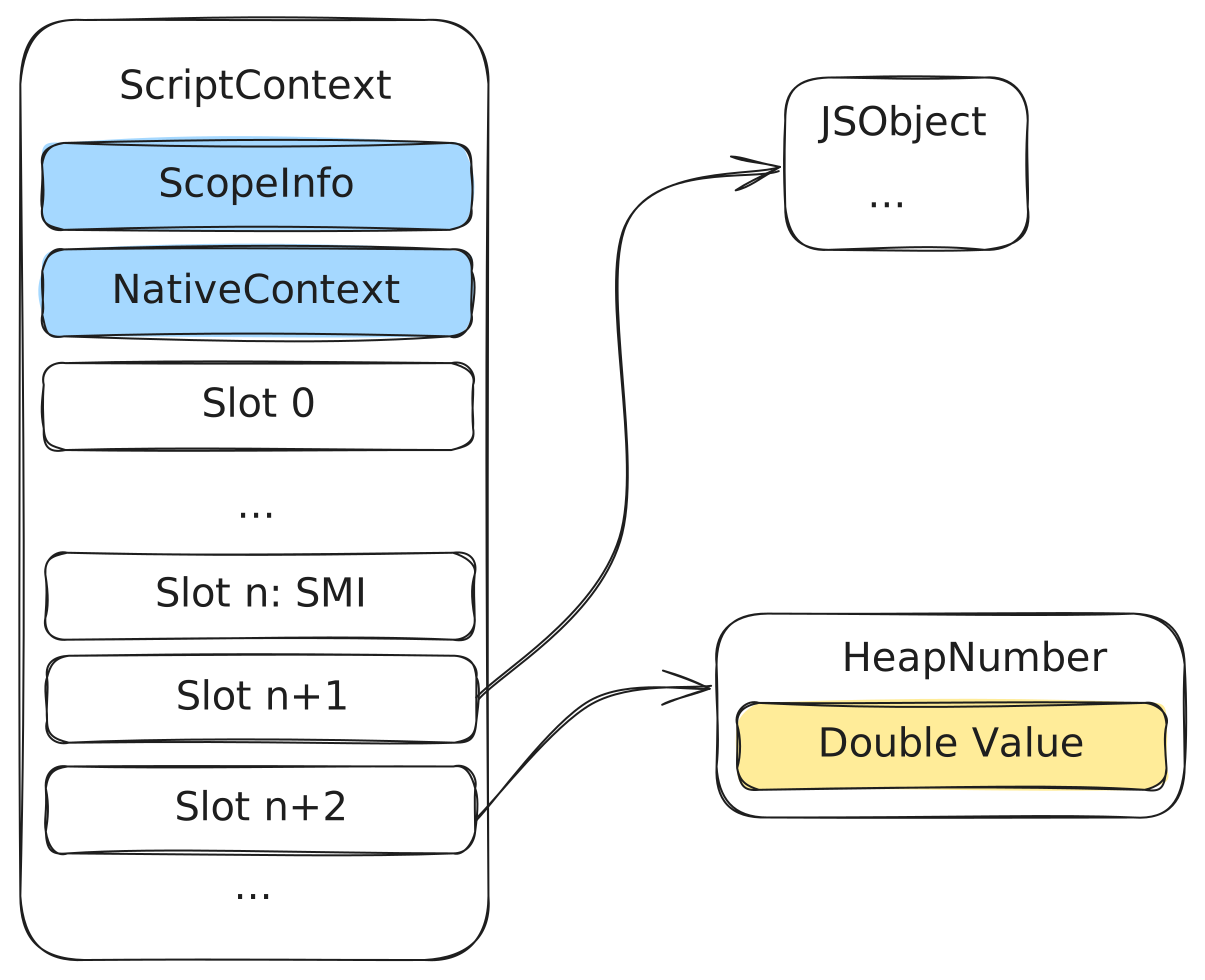
The async-fs benchmark uses a custom, deterministic implementation of Math.random to ensure consistent results across runs. This function updates a seed variable stored in the ScriptContext—a special storage array for variables accessible within a script.
Internally, V8 represents numbers either as small integers (SMIs) stored directly in 31 bits, or as heap-allocated HeapNumber objects for larger or fractional values. The seed variable was stored as a HeapNumber, meaning each update required allocating a new immutable object on the heap.
“Every call to Math.random triggered a new heap allocation, which became a significant bottleneck,” the engineer explained. “The ScriptContext slot pointed to a HeapNumber, but that number never mutated—it was replaced entirely.”
Background: V8’s Tagged Value System
V8 uses a compact tagged-value scheme for 64-bit systems: each slot in the ScriptContext occupies 32 bits. The least significant bit acts as a tag: 0 indicates a 31-bit SMI (value left-shifted by one), while 1 indicates a compressed pointer to a heap object.
HeapNumbers are immutable 64-bit doubles stored on the heap. For frequently updated numbers, this design forces constant garbage collection overhead—precisely what the async-fs benchmark suffered from.
“The optimised solution stores the seed as a mutable double directly in the context, bypassing heap allocations entirely,” the V8 team noted.
What This Means
While the optimization was inspired by a synthetic benchmark, the same pattern appears in real-world JavaScript. Any code that repeatedly updates a numeric variable in a persistent scope could benefit.
“Developers using custom random number generators or counter logic might see performance gains after this V8 update,” said a performance analyst from Mozilla (unaffiliated). “It’s a great example of how engine-level tweaks can ripple across the ecosystem.”
The fix contributes to a noticeable bump in the overall JetStream2 score, reinforcing V8’s position as a leading JavaScript engine for both browsers and server environments like Node.js.
For further reading, see the V8 tagged value internals and the implications for developers.
Related Articles
- Rivian's Georgia Factory: 7 Essential Updates After DOE Loan Reduction
- Pentagon Freezes 165 Wind Farm Approvals, Citing Radar Interference Risks
- 6 Key Updates in React Native 0.85 You Should Know
- How Wind and Solar Slashed UK Gas Imports by £1.7 Billion: A Step-by-Step Guide
- The Zero Revolution: Tapping into AI Model Sparsity for Energy-Efficient Computing
- Inside the Courtroom Drama: Greg Brockman’s Testimony in the Musk-OpenAI Legal Battle
- A Closer Look at the Motorola Razr Fold: The Ultimate Guide to Its Features
- 6 Critical Security Blind Spots in Anthropic Skills You Must Know