Beyond Pattern Matching: How AI and Autonomous Agents Are Redefining Intrusion Detection
For decades, intrusion detection systems (IDS) relied on a straightforward premise: if you know what an attack looks like, you can catch it every time. Signature-based detection methods scanned network traffic for predefined patterns—byte sequences, known malicious IPs, or specific command strings. But as cyber threats grow more sophisticated, that once-reliable approach is showing its limits. The industry is now shifting from a “does this match a known threat?” mindset to a far more nuanced question: “does this behavior make sense given the context?”
This transformation is being driven by two powerful forces: machine learning (ML) and agentic artificial intelligence. Combined with innovations like SnortML, the architecture of intrusion detection is evolving into something smarter, faster, and far more adaptive. In this article, we’ll explore how these technologies are reshaping the security landscape—and what it means for defenders on the front lines.
The Limits of Signature-Based Detection
Signature-based IDS, such as early versions of Snort, rely on a database of known attack signatures. When a packet matches a signature, an alert is triggered. This method is fast and reliable for well-known threats like SQL injection attempts or known malware payloads. However, it comes with a critical weakness: it cannot detect what it hasn’t seen before.
Zero-day exploits, polymorphic malware, and advanced persistent threats (APTs) often evade signature-based detection because they don’t match any existing rule. Attackers also use obfuscation techniques—changing packet order, encoding payloads, or leveraging legitimate services—to slip past the scanners. The result? A high number of false negatives and a growing blind spot in network security.
To overcome this, many organizations have turned to anomaly-based detection, which compares current activity against a baseline of “normal” behavior. But traditional anomaly detection often produces too many false positives, overwhelming security teams and reducing trust in the system. This is where machine learning steps in.
How Machine Learning Changes the Game
Machine learning brings a fundamentally different approach: instead of hardcoded rules, ML models learn from data. They analyze massive streams of network traffic, identifying patterns and correlations that humans—or static rules—might miss. This enables the system to flag suspicious behavior based on probability and context, rather than exact matches.
For example, an ML model might learn that a user typically logs in from a specific geographic region and accesses certain files during business hours. If that same user suddenly connects from an unfamiliar country at 3 AM and starts downloading sensitive data, the model can raise an alert—even if the traffic itself doesn’t match any known attack signature.
ML-based IDS can also adapt over time. As the model is exposed to new data, it refines its understanding of what’s normal and what’s malicious. This continuous learning loop helps reduce false positives while catching novel threats. However, ML alone still has limitations: it requires significant computational resources, careful tuning, and—most importantly—it doesn’t always explain why it flagged an event. That’s where agentic AI and systems like SnortML come into play.
Agentic AI: Autonomous Decision-Making in Security
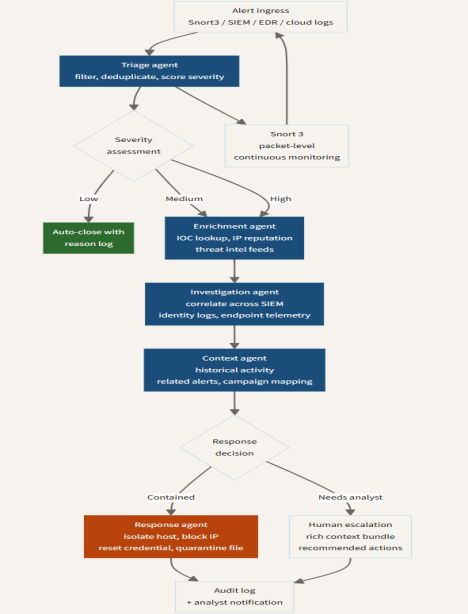
The next evolution in intrusion detection is agentic AI—autonomous agents that can perceive their environment, reason about it, and take action without human intervention. Unlike a passive ML model that simply classifies traffic, an agentic system can proactively investigate alerts, correlate data from multiple sources, and even initiate countermeasures.
Think of it as a digital security analyst that never sleeps. An agentic IDS might detect an anomaly, automatically query threat intelligence feeds, check endpoint logs, and then decide whether to block the connection or escalate to a human—all in real time. This self-directed behavior is a paradigm shift from “wait and respond” to “sense and act.”
Agentic systems also improve the accuracy of detection. By gathering additional context—such as the user’s role, the device’s security posture, or recent vulnerabilities—the agent reduces uncertainty. A single suspicious packet might be innocent if it comes from a partner vendor under a maintenance window, but malicious if it originates from an unknown device in the parking lot. Agentic AI can make that distinction.
SnortML: Bridging Rules and Learning
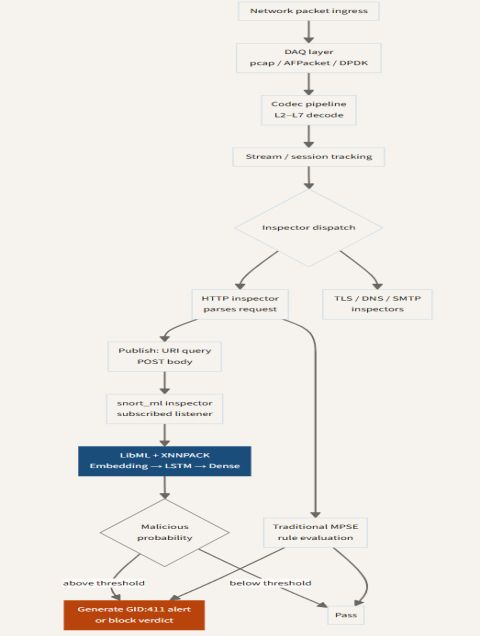
SnortML is a specific implementation that marries the reliability of signature-based detection with the flexibility of machine learning. Built on top of the established Snort IDS, SnortML adds an ML inference engine that runs alongside traditional rules. This hybrid architecture allows the system to:
- Use signatures for known threats (fast and efficient).
- Apply ML models to flag behavior that deviates from normal baselines.
- Correlate results from both engines to reduce false positives and improve detection rates.
What makes SnortML particularly powerful is its ability to run on the same pipeline. Instead of switching between separate tools, security teams get a unified view. The ML models can be custom-trained on their own network traffic, making detection highly tailored. And because SnortML is open-source, organizations can audit the models and contribute improvements.
By blending pattern matching with probabilistic learning, SnortML addresses the core weakness of signature-based systems: context. It doesn’t just ask “is that a known exploit?” It asks “does this traffic look suspicious given everything else we know?”
Evolving Architecture: From Monolithic to Modular
The rise of ML and agentic AI is also reshaping the architecture of intrusion detection. Traditional IDS were often monolithic: a single appliance that inspected all traffic at one chokepoint. Today’s approach is more distributed and modular.
Key architectural trends include:
- Edge-based detection – ML models run directly on routers, switches, or IoT devices, enabling real-time inference without sending all data to a central server.
- Cloud integration – Threat intelligence feeds and compute-heavy model training happen in the cloud, while lightweight inference occurs on-premises.
- Agent orchestration – Multiple autonomous agents coordinate—some monitor traffic, others check endpoints, others simulate attacks to test defenses. They share findings via a central bus.
- Feedback loops – When an agent identifies a new attack, it can update the signature database or retrain the ML model automatically, closing the loop.
This modular design is more resilient. If one component fails, others remain operational. It also scales naturally: as the network grows, new agents or sensors can be added without rebuilding the entire system.
Conclusion: A Smarter, More Adaptive Defense
The shift from “does this match a known pattern?” to “does this make sense in context?” marks a profound change in intrusion detection. By combining signature-based reliability with machine learning’s adaptability and agentic AI’s autonomy, organizations can achieve a level of security that was previously impossible.
SnortML exemplifies this evolution, offering a practical, open-source bridge between legacy systems and modern intelligence. As threats continue to evolve, the detectors that thrive will be those that can learn, reason, and act on their own—turning every byte on the wire into a meaningful story, not just a yes/no match.
Related Articles
- Beyond the Demo: The Real-World Test for Bionic Technologies
- DAIMON Robotics Unveils Daimon-Infinity: A Giant Leap in Robotic Touch
- Q&A: Industrial Automation Threat Landscape in Q4 2025 – Trends and Key Threats
- Dyson's Spot + Scrub Ai: A Mopping Marvel That Stumbles on Vacuuming
- Google Search's AI Overhaul: End of an Era for Links and Publishers
- How to Defend ICS Computers Against Q4 2025 Threat Trends
- 10 Essential Strategies for Testing Non-Deterministic Agent Behavior in CI/CD
- When Should an AI Explain Itself? A Framework for Agentic Transparency