10 Critical Insights Into Russia's OAuth Token Theft via Router Hacks
10 Critical Insights Into Russia's OAuth Token Theft via Router Hacks
In a sophisticated cyber espionage campaign, Russian military hackers have exploited aging routers to silently harvest OAuth authentication tokens from Microsoft Office users. Dubbed “Forest Blizzard” (also known as APT28 and Fancy Bear), this state-backed group compromised over 18,000 networks without deploying malware. Below are the ten essential facts you need to know about this alarming operation.
1. The Campaign Targets Microsoft Office OAuth Tokens
Hackers linked to Russia’s GRU are using compromised routers to intercept OAuth tokens — digital keys that grant access to Microsoft Office accounts without requiring a password. By hijacking these tokens, the attackers can silently enter emails, documents, and cloud services, often without triggering security alerts. The tokens are transmitted after a user successfully logs in, making them a prime target for stealthy surveillance.

2. Over 200 Organizations and 5,000 Consumers Affected
Microsoft disclosed that the espionage network ensnared more than 200 organizations and 5,000 consumer devices. The victims span government agencies, law enforcement bodies, and third-party email providers. This broad targeting suggests the Kremlin is seeking intelligence from both high-value diplomatic targets and ordinary citizens, using the stolen tokens to monitor communications and gather sensitive data.
3. Attribution to Russia’s Military Intelligence (GRU)
The threat actor, commonly tracked as Forest Blizzard, APT28, or Fancy Bear, is attributed to Russia’s General Staff Main Intelligence Directorate (GRU). This group previously gained notoriety for hacking the Democratic National Committee during the 2016 U.S. election. Their involvement underlines the strategic importance of this router-based campaign, marking it as a state-sponsored intelligence operation.
4. Peak Activity Occurred in December 2025
Researchers from Black Lotus Labs, the security division of internet backbone provider Lumen, identified December 2025 as the peak of the surveillance dragnet. At that time, more than 18,000 routers were actively being used to redirect traffic and harvest tokens. The timing suggests a coordinated push to maximize data collection, likely to support geopolitical objectives during a period of heightened global tensions.
5. No Malware Required — Just Router Exploitation
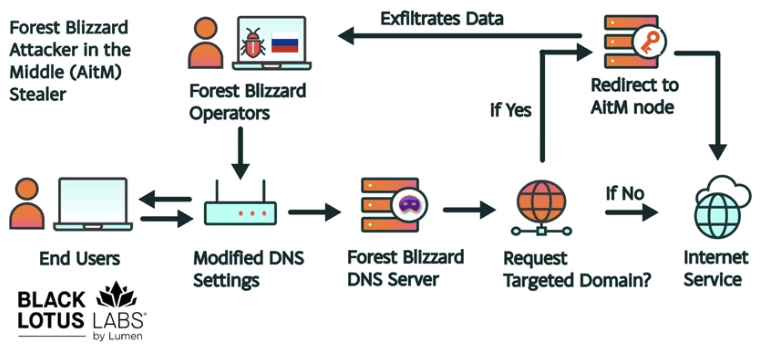
One of the most alarming aspects of this campaign is that the GRU hackers did not install any malicious software on the compromised routers. Instead, they exploited known vulnerabilities in older devices — primarily from MikroTik and TP-Link — to modify the routers’ DNS settings. This “living off the land” approach makes detection extremely difficult, as no malware signatures are present.
6. How DNS Hijacking Works in This Attack
Domain Name System (DNS) hijacking is the core technique. The attackers altered the routers’ configuration to point to rogue DNS servers under their control. When a user typed a legitimate website address, the compromised DNS server redirected them to a malicious lookalike site. This allowed the hackers to capture login credentials and, critically, intercept OAuth tokens transmitted after authentication. The UK’s National Cyber Security Centre (NCSC) issued a warning detailing this method.
7. Old, Unsupported Routers Are the Weak Link
The targeted routers were mostly end-of-life models or far behind on security updates. Many are marketed to small offices and home users (SOHO), where firmware updates are often neglected. MikroTik and TP-Link devices, known for their affordability but inconsistent patching, were particularly vulnerable. Once compromised, these routers became silent gateways for the hackers to harvest tokens across entire local networks.
8. The Attack Propagates to All Network Users
After a single router was hijacked, the malicious DNS settings applied to everyone connected to that local network. This means employees in a government ministry or customers of an email provider could all be affected without any direct action on their part. The attackers could sit back and collect OAuth tokens from multiple users simultaneously, amplifying the scale of the breach.
9. Targeting Focuses on Government and Diplomacy
Lumen’s report highlights that the hackers primarily went after ministries of foreign affairs, law enforcement agencies, and third-party email service providers. This selection aligns with classic espionage objectives: gaining access to diplomatic communications, police investigations, and the internal emails of officials. The use of OAuth tokens provides persistent, undetected access to these high-value accounts.
10. Defending Against This Threat Requires Router Hygiene
To protect against such attacks, organizations and individuals must routinely update router firmware, replace end-of-life devices, and monitor for unusual DNS changes. Network administrators should enforce strong authentication for router management interfaces and use DNS monitoring tools to detect hijacking attempts. As the NCSC advises, treating routers as critical infrastructure is key to preventing these stealthy token thefts.
Conclusion
The Russian GRU’s router-based OAuth token theft campaign reveals a troubling evolution in state-sponsored espionage. By exploiting outdated hardware and DNS vulnerabilities, the attackers achieved widespread, malware-free access to sensitive accounts. This incident underscores the urgent need for organizations to harden their network edge devices and adopt advanced threat detection measures. As cyber threats grow more sophisticated, the humble router has become a frontline battleground.
Related Articles
- Shadow AI Apps Expose Sensitive Data at Scale: 380,000 Vibe-Coded Assets Found Publicly Accessible
- Mastering Enterprise Secret Management on Kubernetes with Vault Secrets Operator
- DNA Breakthrough: Four More Franklin Expedition Sailors Identified After 170 Years
- 10 Ways Docker and Mend.io Revolutionize Container Security and Save Developer Hours
- The Human Factor: How One Click Can Trigger a Breach and How to Stop It
- Google's Bug Bounty Shift: Chrome Rewards Drop, Android Payouts Soar Amid AI Focus
- Škoda Auto Reveals Customer Data Compromised Following Cyberattack on E-Commerce Platform
- OceanLotus Exploits PyPI in Sophisticated Supply Chain Attack, Deploys Novel 'ZiChatBot' Malware